


I’ve said it before, and I’ll definitely say it many more times than anyone cares to hear it: even ten years later, I am still floored by the power psilocybin mushrooms had to profoundly change my life. The experience dissolved old traumas I had carried for years and opened the door to healing in ways that nothing else ever had. Like so many with similar experiences, I began to wonder what could happen if more people had access to the same kind of healing.
For the better part of a century now, people moved by the power of psychedelics have suggested that widespread access to them could help heal division. Recent books like How Psychedelics Can Help Save the World (2022) argue that boundary-dissolving experiences make people more eco-conscious, compassionate, and less dogmatic.
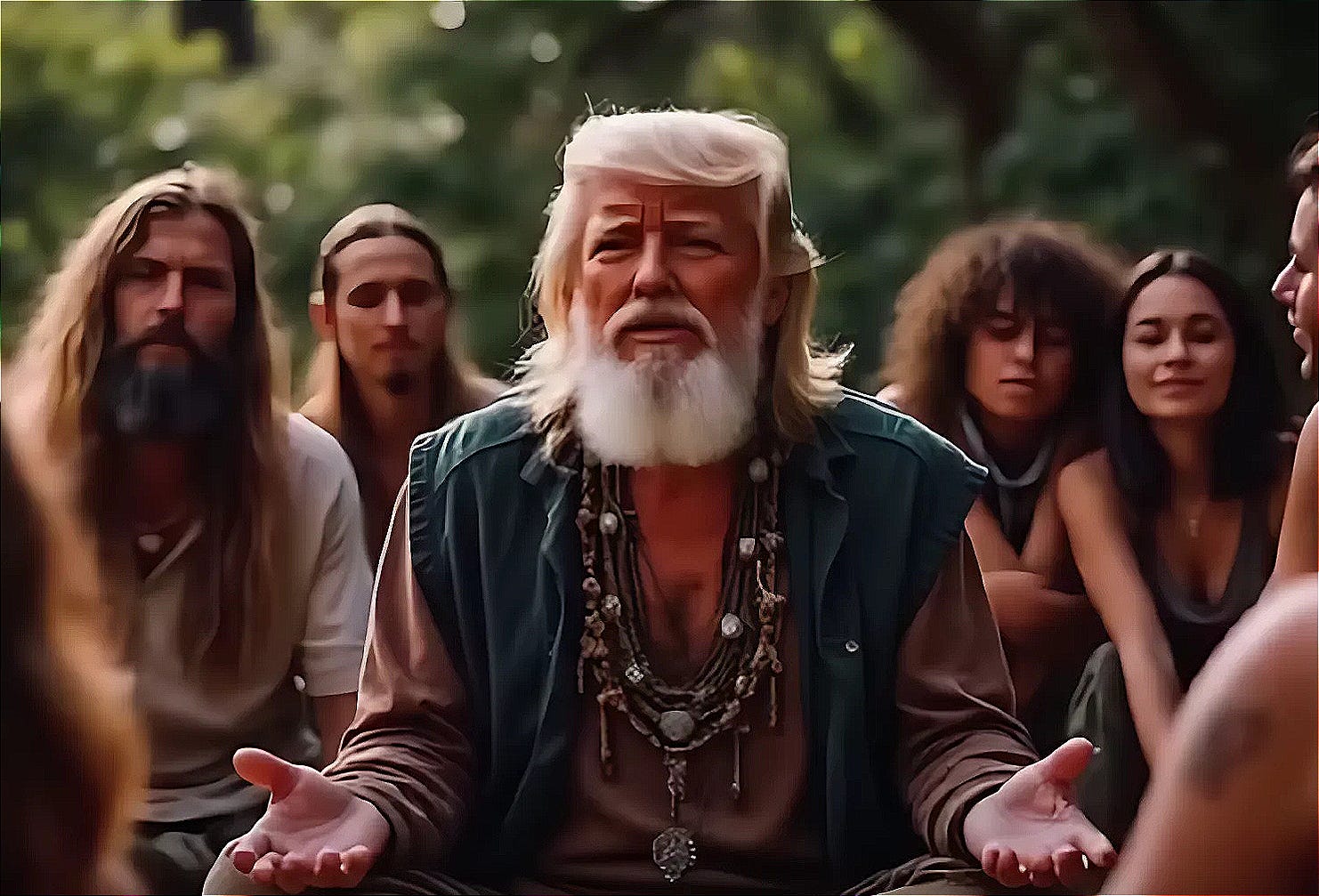
It’s become a cliché: if only politicians would drink ayahuasca, they’d return transformed. Late last year, a viral video used AI-generated imagery to play out that fantasy with Joe Biden, Donald Trump, and Elon Musk.
A Blind Spot in the Movement
However, it seems the power of psychedelics to transform depends on something else entirely. Psychedelics had the power to change me because I was already willing to admit when I was wrong and open to being changed by new information. As most of us know all too well, not everyone is like that.
I don’t say this to toot my own horn. For me, humility and openness were tied to insecurity. A shaky foundation in childhood left me unsure of my place and doubtful of my worth. Some people are naturally open, and I think I was too, but my self-doubt made me skeptical of almost everything while also keeping me searching for answers. In short, I never took what I thought I knew for granted.
For others, insecurity does the opposite. Instead of curiosity, it hardens into defensiveness, often rooted in fear of being judged or losing control. As Gabor Maté shares in the film The Wisdom of Trauma, these patterns are not weaknesses but survival techniques. Closing off has been a way to endure harsh conditions where vulnerability was not allowed. Seen this way, defensiveness is less stubbornness than it is a protective measure that once served a vital purpose.
This matters when we talk about psychedelics. Many psychonauts agree that psychedelics act as non-specific amplifiers. They magnify what's already there. If you go into the experience closed off, you might reject anything that doesn't already fit your worldview. If you go in curious and humble, psychedelics can open doors. But they don’t guarantee openness.
Take Aldous Huxley. Nearly a decade before he ever tried mescaline, he had already described in Time Must Have a Stop (1944) the kind of shift in awareness people now associate with psychedelics.
As Laura Archera Huxley later wrote in This Timeless Moment (1968):
The most amazing fact is that Aldous had written Time Must Have a Stop some ten years before he had taken mescaline, yet in the passage describing the transit between two states of consciousness the same preternatural quality of certain aspects of the psychedelic experience is conveyed. The door which later opened wide was already ajar.
In other words, Huxley didn’t need the drug to glimpse those states; he had the openness and imagination already.
What some psychedelic advocates, especially those convinced psychedelics can change the world for the better, often overlook is the role of nature and education in shaping how people experience and integrate their trips. Even those who return proclaiming “we are all one” may treat that oneness as conditional.
You can dissolve into cosmic unity on Saturday night and still wake up Sunday morning ready to shun your neighbor with the "wrong" yard sign.
Echo Chambers, Old and New
Social media has supercharged our echo chambers, feeding us outrage and division daily. Even in psychedelic spaces, which pride themselves on openness, intolerance toward certain viewpoints is common.
I’ve experienced this firsthand and go over it in part 1: Authoritarianism in Psychedelic Spaces: A Mirror the Left Won’t Face.
The ethnobotanist and psychedelic philosopher Terence McKenna often warned that "culture is not your friend." By that he meant that the systems we live in, political, economic, even subcultural, are designed to shape and control us, not necessarily to free us. Psychedelics don’t erase the authoritarian impulse. The urge to silence or punish those who think differently is ancient, and it exists in every political tribe. I don’t think this is the archaic revival McKenna had in mind.
My experiences in the psychedelic subculture have made it clear that the rights we take for granted are never guaranteed. Free speech is never permanently won. It must be constantly taught and defended. The authoritarian instinct does not vanish just because someone has taken mushrooms. Bummer.
The utopian dream of the 1960s counterculture reminds us of this. For all its peace-and-love rhetoric, that generation didn't escape intolerance. Communes and collectives collapsed under the weight of charismatic leaders, and a refusal to tolerate differences. And many of our hippie boomer brethren who railed against the corruption of the establishment in their youth are today glued to mainstream media to inform their opinion. Outrage and activism culture have been co-opted by corporations, especially since the rise of the Occupy Wall Street movement, which Vivek Ramaswamy documents in his book Woke Inc. He explains how the elite, recognizing the power of Occupy to unite people across race and gender around class solidarity, redirected the struggle from class to identity.
It's left me wondering for years now: If those of us who claim to have "seen beyond the veil" can't see the scam, what chance does the rest of society have? Shouldn’t psychedelic insights offer at least some safeguard against the same traps of conformity and resentment that so many fall into without them?
Of course, being aware of the cosmic "ultimate reality" doesn't erase the very real harms people face Earthside, no matter how illusory it all may be (what many refer to as spiritual bypassing). Aldous Huxley put it well: “We must not live thoughtlessly, taking our illusion for the complete reality, but at the same time we must not live too thoughtfully in the sense of trying to escape from the dream state. We must be continuously on our watch for ways in which we may enlarge our consciousness.”
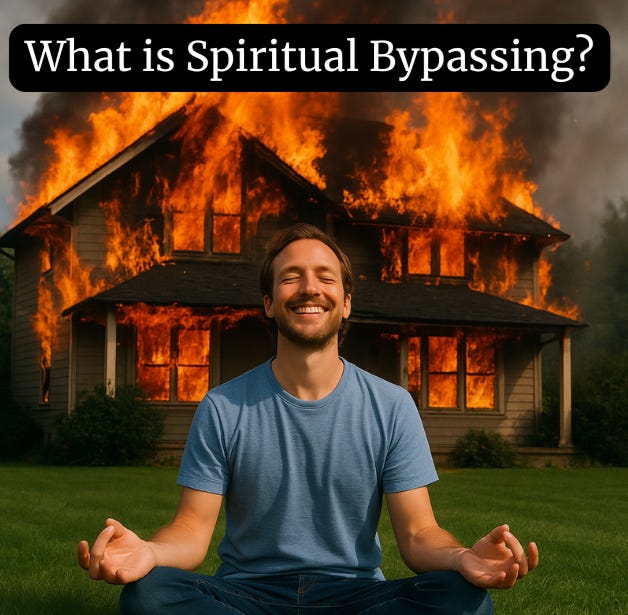
Put another way; to live fully, we must keep one foot in each realm. We become the bridge, holding both the dream and the reality, both the transcendent and the practical, without abandoning either.
As above, so below, and all that.
So, What Now?
I’ve been properly disabused of any naive notion about the power of psychedelics to heal the world, mighty as they be. If we want to truly expand our minds, we need to prime them to feel unthreatened to receive new insights, and we need to learn to share insights in ways that diffuse fear and defensiveness in others.
How do we do this? I started writing this article intending to promote bridge-building organizations and techniques as a starting point. These groups are making a difference, and I have learned many invaluable tools from them. However, something that should have been obvious occurred to me recently: people hate bridge builders. They see us as fence-sitters and filthy centrists, and respect us even less than the people they oppose. If someone is not open to considering other viewpoints, they will not attend a bridge-building session. Or they will attend, walk away, and label the organization as problematic as soon as they’re confronted with opinions that make them uncomfortable. I wanted to try to reach these people, but after some of the harsh responses to my last article, the friends I lost for defending Charlie Kirk’s right to hold his beliefs without being killed for them, and the overwhelming support for political violence from the Left that the tragedy revealed, I no longer believe these people can be reached. At least, not as they are now. Some people simply do not have the disposition for it.
Philosopher and co-author of How to Have Impossible Conversations Peter Boghossian argued on a recent appearance of Last Meal with Tom Nash that what people need in order to consider new viewpoints is to acquire a specific mindset: “Good, clear thinking is… about an attitudinal disposition… It’s very, very difficult for people who don’t possess the attitudinal disposition to somehow acquire it.” Cultivating this disposition and asking ourselves, “How could I be wrong about that?” opens the door to genuine understanding, but it’s a tough habit to form when people cling to beliefs for belonging.
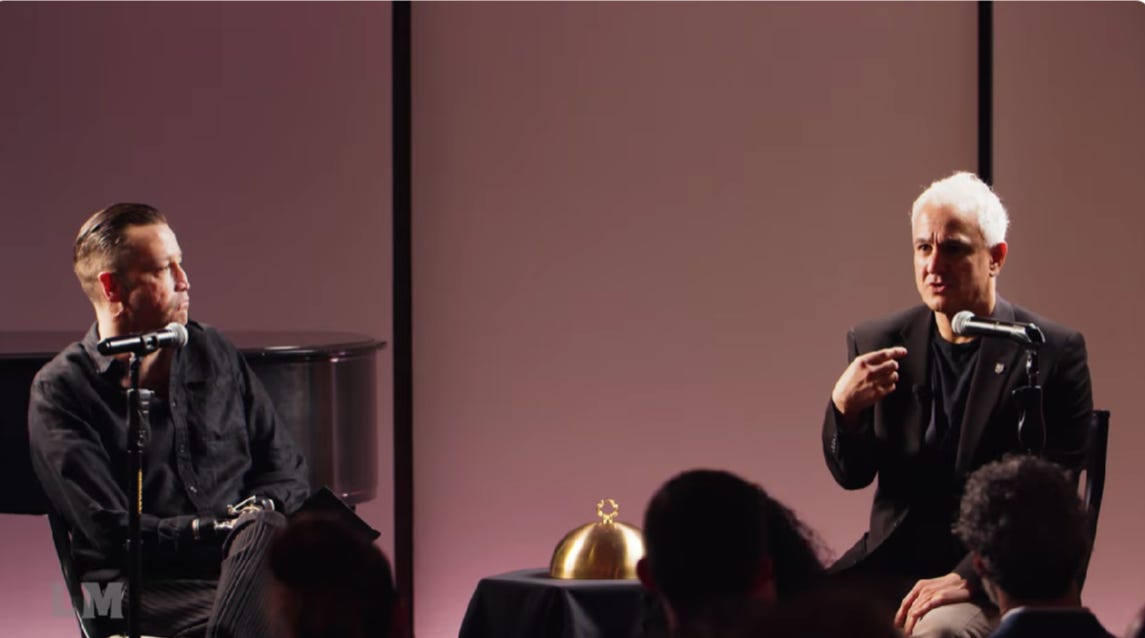
Boghossian further explains: “Virtually nobody formulates their beliefs on the basis of evidence… We want to belong, we want to be loved… that’s one of the few things we want more than to be right.” The need for love and belonging is a fundamental human trait. So fundamental that it slips under the radar and we are mostly unaware of how much it controls us. Although the threat of losing one’s career and livelihood for speaking against dominant narratives is a legitimate concern, supported by numerous documented cases, most people no longer live in social structures where group ostracization equates to a literal threat to survival. But we may as well be. Our hard wiring is the same. It’s ancient mechanics that we have to become aware of and work with. Otherwise, we stay clinging to groups where we can’t really be ourselves, no matter the cost elsewise. What many aren’t aware of is the liberation that exists once they speak out and their exile begins.
I was “canceled” as a child by my parents as the family scapegoat and never felt accepted by my peers for who I was. Today, I know the freedom that exists on the other side of that, and what it feels like to be loved by people for who I am and what I believe in. Many others describe being canceled as the catalyst that opened their eyes and led them to deeper connections with people who genuinely know and value them. Once the loss of belonging becomes real, the pressure to conform lifts, and with nothing left to lose, people can finally be themselves.
Boghossian captures the power of this authenticity: “If you live your life and you lie, or you’re not completely transparent in your life, the consequence of that is that… nobody will really know who you are… You’ll never develop an authentic relationship with anybody.”
It’s not a new idea that truth is the foundation of connection. We’ve all heard some version of be honest, be real, be yourself. But I think we underestimate just how literal and uncompromising this is. Without truth, the relationships we build aren’t really ours. They’re built on a version of us we curated to avoid discomfort or rejection. If you want real connection, you have to tell the truth. If you lie, the connections you create might not be real at all.
And we have to show love to the people who go against the grain, understanding that it’s almost always easier to simply go along with the group, and acknowledge the courage it takes to do otherwise. Maybe they have something crucial to teach us. Groups that do not allow critique or dissenting voices often alienate people to the point of losing them, or they fail because they ignore valuable input. From a practical standpoint alone, rejecting disagreement is simply bad for business.
Of course, some have made being contrary for the sake of it a virtue, a la Nick Fuentes and his outspoken admiration of Hitler, amongst other things. But we’re going for authenticity here, not reactive cries for attention.
Many suggest that Fuentes’ rise to prominence is a response to the intolerance and the preponderance of baseless accusations from the Left. Someone being falsely labeled a Nazi too many times has nothing to lose and a ton of resentment and perhaps figures they may as well become a Nazi. Nick Fuentes spoke to a generation of young men who were told they were inherently toxic, rejected for who they were, and given neither support nor direction, and who in response became something worse. If people are allowed to speak freely without having the worst assumed of them, and if critique is delivered with care rather than condemnation, the edgelords lose their edge. We give people a reason to improve when we make it okay to be wrong, and when we hold the possibility that we might be wrong too. If we sit upon a throne of righteousness that others can never ascend, there is no incentive to grow.
What Being Psychedelic Really Means
In the early days of my psychedelic inquiry, I treaded very carefully. I spent years reading about psychedelics before ever trying them. Part of what made me feel comfortable eventually exploring them was the humility I saw in Terence McKenna’s approach. He carried a striking modesty in how he spoke about his psychedelic insights.
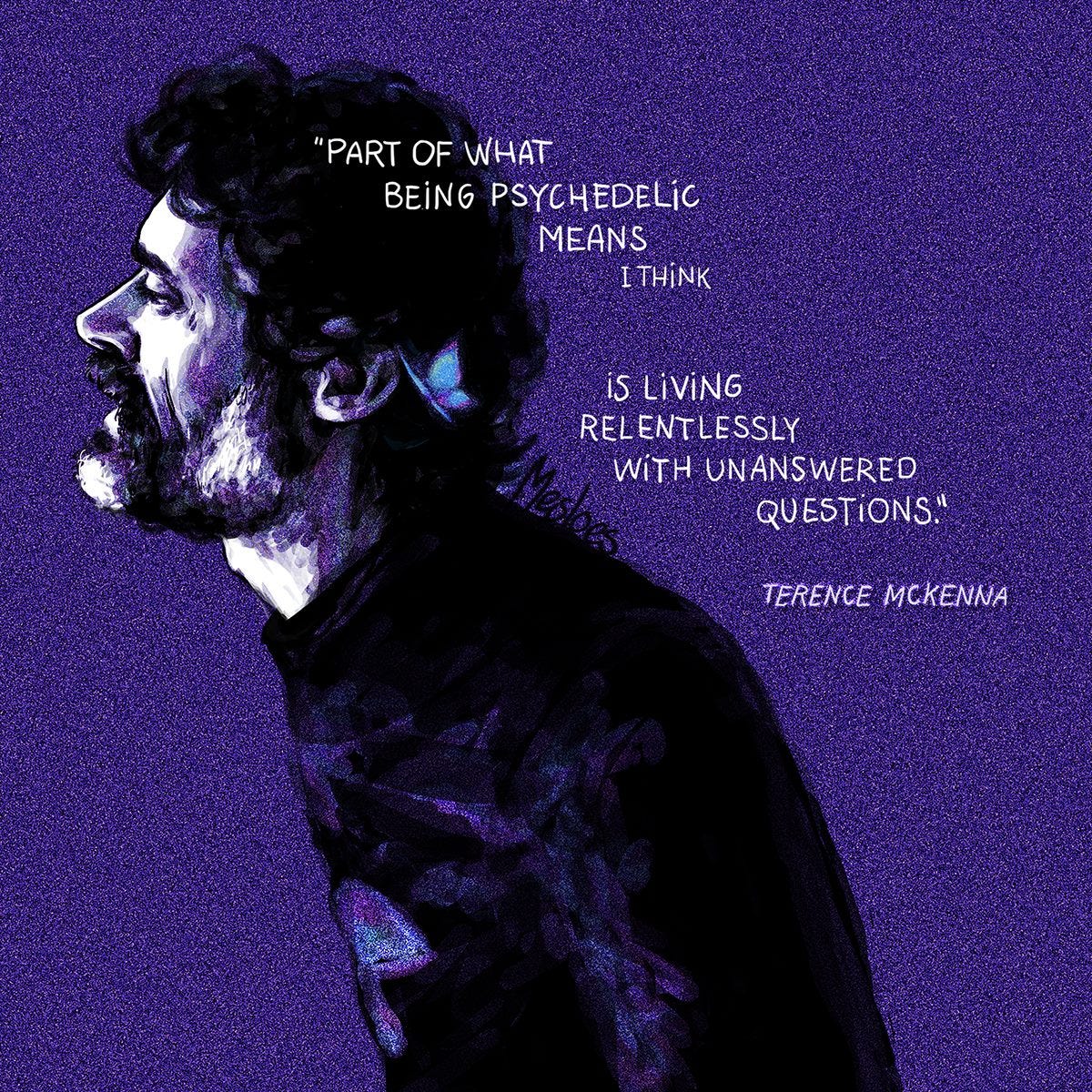
He often reminded his listeners to stay skeptical of psychedelic phenomenology or theories, once saying, “I don’t believe this stuff. I entertain ideas, but I don’t give belief over,” and warning that “you have to be careful not to believe your own line.” And a personal favorite of McKenna’s: “Part of what being psychedelic means, I think, is living relentlessly with unanswered questions.” That willingness to admit his ideas could be mistaken and his comfort with ambiguity made me take his position more seriously.
The real magic of psychedelics only happens when we meet them with openness and humility. Without it, nothing shifts. We cannot expect those who thrive on rigid certainty to be fundamentally changed by mushrooms.
But we can choose differently. Those who are willing to be humbled, to admit “I could be wrong,” are the ones who can be transformed. And if enough of us take that seriously, I think the collective tide could begin to turn. That’s how we make the shift: not by waiting for politicians to have revelations, but by ordinary people embracing humility and openness to new insights until leaders have no choice but to follow.
McKenna also famously quoted Walt Whitman: “Do I contradict myself? Very well then, I contradict myself. I am large, I contain multitudes.” Psychedelic thinking encourages us to embrace that kind of complexity, to see that reality is far richer than our instinct to collapse it into something simple, and to consider that this truth might be far more exciting than frightening.
Another sentiment I think is worth remembering comes from Timothy Leary: “You are only as young as the last time you changed your mind.”
The Refuge We Need
I think the real promise of psychedelics isn't in creating a particular political outcome, but in building a cultural refuge where freedom of thought and expression are truly honored.
Right now, many psychedelic communities claim to value openness, but in practice they only allow the "right" kinds of expression.
I know this sounds like a basic concept, but it still needs saying: If psychedelics are going to play any role in healing polarization, it won’t be by forcing one worldview on everyone. It will come from creating spaces where difficult conversations and diverse perspectives are met with curiosity and an understanding of our shared humanity rather than condemnation.
I want to be part of a psychedelic movement that embraces the wisdom that Huxley and McKenna arrived at in their later years. For all their waxing poetic and psychedelic philosophizing, to me the most profound of their messages are also the most simple;
Aldous Huxley admitted at the end of his life:
"It is a little embarrassing that, after forty-five years of research and study, the best advice I can give to people is to be a little kinder to each other."
Terence McKenna said in his final months:
“At the end of the day, it is really about love. That is the only thing that matters, the only thing we take with us.”
If psychedelics reveal that we are all connected, that means accepting that others may be unaware of it, express it differently, or reject it entirely. And still, we are called to love.
Our task now, in my humble opinion, is to create spaces where we can embody this kind of love. Spaces where people can wrestle with complexity, engage with challenging ideas, and treat disagreement as an opportunity for growth. Even if no consensus is reached, we leave with a deeper understanding of how another drop in the cosmic ocean thinks and feels, and that alone is worth the price of admission.
Brilliant article! Very well done!
Great piece! Thanks for the Last Meal shout out! :)